Over eighty percent of american medical decisions rely on accurate diagnostic testing to guide treatment. Clinical diagnostics shape the way physicians understand illnesses, decide on therapies, and protect patient health across communities. Mastering the core principles behind these tests helps both professionals and patients appreciate how new technologies and rigorous standards turn complex symptoms into life-changing answers.
Table of Contents
- Defining Clinical Diagnostics And Core Principles
- Types Of Diagnostic Tests And Applications
- Laboratory Processes And Advanced Technologies
- Ensuring Accuracy, Reliability, And Security
- Clinical Diagnostics Versus Alternative Testing
Key Takeaways
| Point | Details |
|---|---|
| Importance of Clinical Diagnostics | Clinical diagnostics provide essential insights into patient health through systematic testing, crucial for effective treatment planning and monitoring. |
| Types of Diagnostic Tests | Tests are categorized as diagnostic, predictive, screening, and research-oriented, each catering to specific healthcare needs. |
| Advancements in Technology | Advanced methodologies like Next Generation Sequencing and molecular diagnostics enhance precision and personalization in medical care. |
| Quality Assurance and Security | Ensuring accuracy, reliability, and security in diagnostics is vital, requiring stringent protocols and data protection measures. |
Defining Clinical Diagnostics and Core Principles
Clinical diagnostics represent a critical foundation of modern healthcare, providing medical professionals with essential insights into patient health through systematic testing and evaluation. According to National Cancer Institute, diagnostic tests are fundamental procedures used to determine the presence of a disease or condition based on a patient’s specific signs and symptoms.
Clinical diagnostics encompass a wide range of testing methodologies designed to identify, assess, and monitor health conditions with precision. As detailed by National Center for Biotechnology Information, these tests can be categorized into two primary types:
- Diagnostic Tests: Used to identify the cause of abnormal physical signs or symptoms
- Predictive Tests: Applied to asymptomatic individuals to provide information about potential future disease occurrence
The core principles of clinical diagnostics revolve around accuracy, timeliness, and actionable insights. These tests serve multiple critical functions in healthcare, including treatment planning, assessing treatment effectiveness, and developing comprehensive patient prognoses. Common diagnostic approaches include:
- Laboratory Tests (blood and urine analyses)
- Imaging Tests (mammography, CT scans)
- Endoscopic Procedures (colonoscopy, bronchoscopy)
- Tissue Biopsies
By leveraging advanced technologies and rigorous scientific methodologies, clinical diagnostics transform complex medical data into clear, interpretable information that guides healthcare decision-making. For more detailed information about diagnostic terminology, check out our guide to diagnostics terminology explained.
Types of Diagnostic Tests and Applications
Diagnostic tests serve as critical tools in modern medical practice, enabling healthcare professionals to detect, assess, and monitor various health conditions with remarkable precision. According to the National Institute of Diabetes and Digestive and Kidney Diseases, physicians employ multiple diagnostic methodologies to comprehensively evaluate patient health.
Diagnostic testing encompasses several primary categories, each serving unique medical investigation purposes:
- Laboratory Tests: Blood and urine analyses that provide insights into metabolic functions, disease markers, and overall physiological health
- Imaging Tests: Visual diagnostic procedures that reveal internal body structures and potential abnormalities
- Endoscopic Procedures: Direct visualization techniques allowing physicians to examine internal organs and cavities
- Biopsy Techniques: Tissue sampling methods for detailed cellular and molecular analysis
Modern diagnostic imaging technologies have revolutionized medical evaluation. As highlighted by the International Atomic Energy Agency, advanced imaging techniques like radiographs, ultrasound, fluoroscopy, and nuclear medicine create sophisticated visual representations of internal body systems. These technologies are particularly crucial in diagnosing complex non-communicable diseases, including:
- Cardiovascular conditions
- Cancer
- Chronic respiratory diseases
- Diabetes
The integration of cutting-edge diagnostic tools enables healthcare providers to develop more targeted, personalized treatment strategies.
IMAGE:descriptive_key_1] For a deeper understanding of diagnostic terminology and approaches, explore our [guide to diagnostics terminology explained.
Laboratory Processes and Advanced Technologies
Laboratory diagnostic processes represent the backbone of modern medical investigation, transforming complex biological samples into actionable medical insights. According to PubMed Central, molecular diagnostic techniques have revolutionized healthcare by enabling precise identification of pathogens and disease markers through advanced methodological approaches.
Molecular diagnostic techniques encompass a range of sophisticated laboratory processes designed to extract critical biological information:
- Nucleic Acid Hybridization: Direct detection of microbial genetic material
- Fluorescence In Situ Hybridization (FISH): Advanced cellular and genetic analysis method
- Line Probe Assays: Specialized techniques for pathogen identification
Cutting-edge technologies continue to push the boundaries of diagnostic capabilities. As highlighted by the American Society for Microbiology, emerging technologies like Next Generation Sequencing (NGS) and advanced spectroscopy are transforming medical diagnostics. These innovative approaches offer unprecedented insights by:
- Capturing comprehensive genomic sequences
- Enabling rapid organism identification
- Providing molecular-level diagnostic precision
- Supporting personalized medical interventions
The integration of these advanced laboratory technologies empowers healthcare professionals to develop more targeted and effective treatment strategies. For a deeper exploration of diagnostic technologies, check out our guide to technology in healthcare diagnostics.
Ensuring Accuracy, Reliability, and Security
In the complex world of clinical diagnostics, maintaining the highest standards of accuracy and reliability is not just a goal—it’s an absolute necessity. According to Jersey College, ensuring test precision requires a multifaceted approach that encompasses rigorous laboratory protocols and comprehensive quality control mechanisms.
Quality assurance in diagnostic testing involves several critical components:
- Equipment Calibration: Precise tuning of diagnostic instruments
- Standardized Procedures: Consistent methodological approaches
- Regular Quality Control: Systematic verification of testing accuracy
- Data Integrity Management: Protecting and maintaining sample information
The reliability of diagnostic tests hinges on multiple intricate factors. As highlighted by MedTech Europe, key determinants of test effectiveness include:
- Test Sensitivity: Ability to correctly identify positive cases
- Test Specificity: Capacity to accurately rule out false positives
- Sample Collection Protocols: Ensuring proper specimen handling
- Standardized Testing Frameworks: Maintaining consistent evaluation methods
Patient confidentiality and data security represent paramount concerns in modern diagnostic processes. Robust cybersecurity measures, encrypted data storage, and strict access controls are essential to protecting sensitive medical information. For comprehensive insights into diagnostic technologies and security protocols, explore our guide to technology in healthcare diagnostics.
Clinical Diagnostics Versus Alternative Testing
Navigating the complex landscape of medical testing requires a nuanced understanding of different diagnostic approaches. According to the Office of Technology Assessment, clinical diagnostics encompass distinct testing methodologies designed to address specific medical investigation needs, each serving unique purposes in healthcare management.
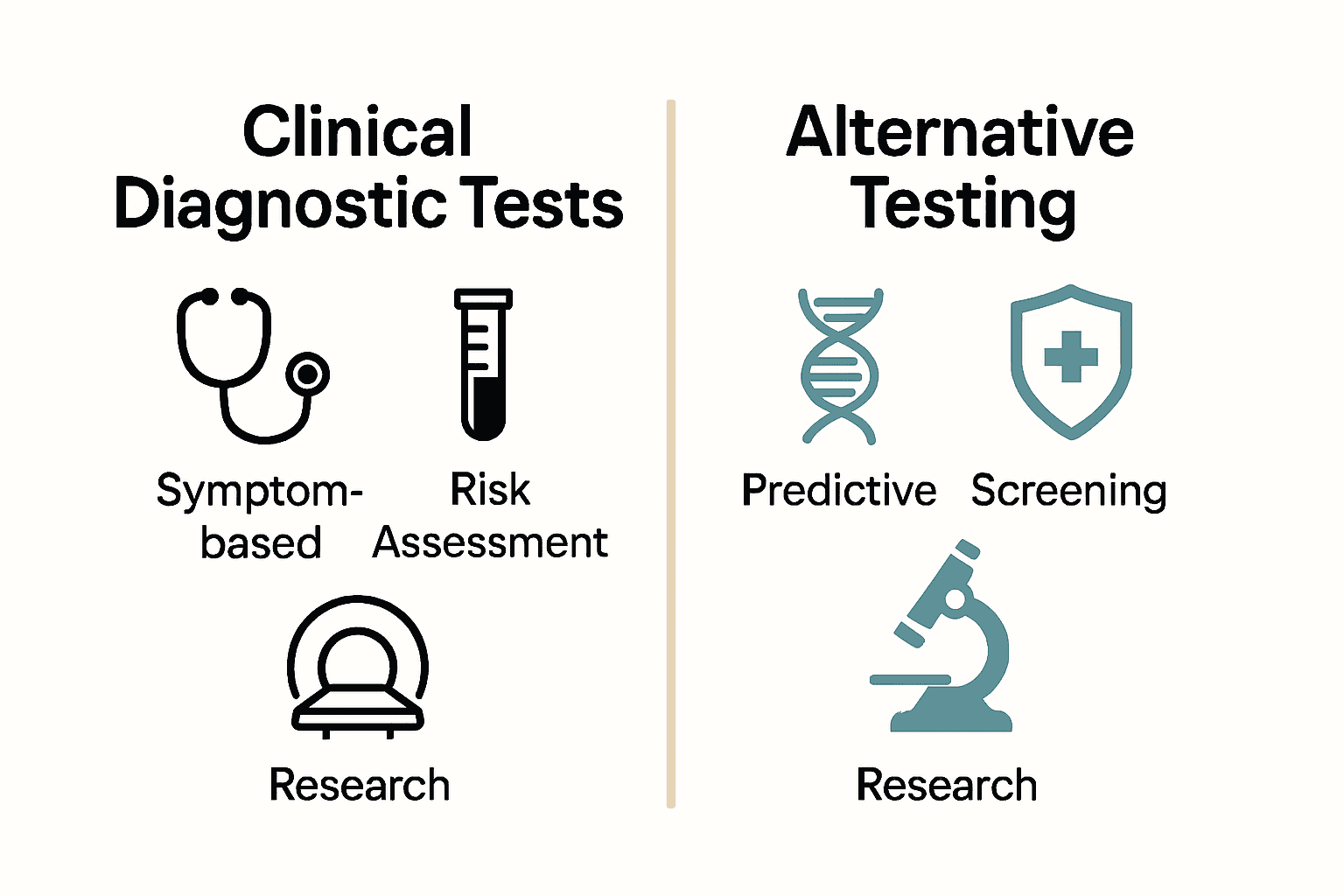
Diagnostic testing can be categorized into several fundamental approaches:
- Clinical Diagnostic Tests: Identify specific health conditions based on existing symptoms
- Predictive Tests: Assess potential future disease risks for asymptomatic individuals
- Screening Tests: Proactively detect potential health issues before symptoms emerge
- Research-Oriented Tests: Explore broader medical understanding and scientific knowledge
The differentiation between clinical and alternative testing becomes particularly pronounced in genetic evaluations. As highlighted by Harvard University’s Cyber Research, genetic tests can serve multiple contexts:
- Clinical Diagnostic Purposes: Direct disease identification and treatment planning
- Preventative Health Screenings: Identifying potential genetic predispositions
- Research-Based Investigations: Expanding scientific understanding of genetic conditions
- Personalized Medical Strategies: Tailoring interventions based on genetic profiles
Understanding these distinctions empowers patients and healthcare providers to select the most appropriate testing approach.
 For comprehensive guidance on selecting the right diagnostic services, explore our guide to choosing diagnostic services.
Elevate Your Clinical Diagnostics Experience with Centra Diagnostics
Understanding the complexity and precision required in clinical diagnostics can be overwhelming when accuracy and speed are vital. This article highlights key challenges such as ensuring test sensitivity and specificity, managing advanced molecular techniques, and securing patient data integrity. If you are seeking reliable diagnostic services that deliver fast turnaround times using cutting-edge technology, Centra Diagnostics in Los Angeles is your trusted partner. We specialize in a wide range of testing including molecular testing, blood work, and COVID-19 diagnostics designed to empower healthcare decisions with confidence.
Discover how Centra Diagnostics addresses your diagnostic challenges with advanced technology and personalized client care. Act now to experience first-class service and expert support for all your health testing needs. Visit our website to learn more or connect with our team. Take charge of your health journey today by exploring our guide to technology in healthcare diagnostics and get the clarity you deserve from expert testing solutions.
Frequently Asked Questions
What are the main types of diagnostic tests used in clinical diagnostics?
Diagnostic tests in clinical diagnostics can be categorized into four main types: laboratory tests (like blood and urine analyses), imaging tests (such as mammography and CT scans), endoscopic procedures (like colonoscopy), and biopsy techniques for tissue sampling.
How do laboratory diagnostic processes work?
Laboratory diagnostic processes involve analyzing biological samples to extract critical information about a patient’s health. Techniques like nucleic acid hybridization and advanced methods such as Next Generation Sequencing (NGS) enable healthcare professionals to identify pathogens and disease markers with precision.
What is the importance of accuracy and reliability in diagnostic testing?
Accuracy and reliability are crucial in diagnostic testing as they ensure that tests provide precise and dependable results, enabling correct diagnosis and treatment planning. This involves rigorous quality control measures, including equipment calibration and standardized testing procedures.
How do clinical diagnostics differ from alternative testing methods?
Clinical diagnostics are specifically aimed at identifying existing health conditions based on symptoms, while alternative testing methods may include predictive and screening tests that assess potential health risks or contribute to medical research without focusing on symptomatic conditions.