A patient’s lab report arrives, but the numbers alone rarely tell the whole story. For providers in Los Angeles, understanding the meaning behind these results means knowing how to use reference ranges as more than a yes-or-no guide. A reference range represents the central 95 percent of values found in healthy individuals, but that still means some healthy patients will fall outside these limits. Here you will find practical tools for interpreting results with confidence, tailored to your diverse patient population.
Table of Contents
- What Are Reference Ranges In Diagnostics
- Types Of Reference Ranges And Variations
- How Labs Determine Reference Ranges
- Interpreting Lab Results Using Reference Ranges
- Risks And Common Pitfalls In Application
Key Takeaways
| Point | Details |
|---|---|
| Understanding Reference Ranges | Reference ranges establish what is considered normal for lab results, typically encompassing the central 95% of values from a healthy population. |
| Variability of Reference Ranges | Reference ranges can vary significantly based on factors like age, gender, and laboratory methods, making context crucial for accurate interpretation. |
| Clinical Correlation | Out-of-range results are indicators for further investigation rather than definitive diagnoses; always correlate with patient history and symptoms before acting. |
| Communication with Patients | Clear communication about lab results and their implications is essential to avoid unnecessary anxiety and interventions for patients. |
What Are Reference Ranges In Diagnostics
When you order a lab test for a patient, the results come back with numbers. But what do those numbers actually mean? That’s where reference ranges come in. A reference range, also called a reference interval, is a statistically defined range that establishes what’s considered normal for a particular test result. Specifically, these ranges represent the central 95% of values observed in a healthy population. Think of it as a benchmark. If a patient’s result falls within this range, they’re in the normal zone. If it falls outside, that signals something might need attention. But here’s the catch that catches many providers off guard: by definition, 5% of completely healthy people will have results outside the normal range. You read that right. A perfectly healthy person could get a result that looks abnormal on paper.
Understanding how reference ranges are actually established matters more than you might think. These ranges come from testing at least 120 healthy individuals, though larger sample sizes provide more reliable data. Labs collect this baseline information, calculate the statistical percentiles, and establish the 95% interval. The problem is that reference ranges can shift significantly based on factors that have nothing to do with pathology. Age changes things. Gender changes things. Ethnicity matters. Seasonality affects some markers. The specific laboratory method used, the equipment, even minor variations in sample handling can nudge results in different directions. In Los Angeles, where you’re serving a diverse patient population across different neighborhoods and demographics, this variation takes on real practical importance. A result that’s normal for a 35-year-old woman might not apply to a 72-year-old man. A value that’s standard in one lab might be flagged in another. The reference range you’re looking at should match the population it’s meant for and the method that produced the result.
This is why clear communication becomes your responsibility as the provider. When you interpret results, you’re not just reading numbers against a range. You’re contextualizing those numbers within the patient’s specific situation, their age, gender, health history, and yes, which lab produced the test. A result outside the reference range doesn’t automatically mean pathology exists. It’s an indicator that warrants investigation, not a diagnosis. You need to ask yourself: Does this result fit the clinical picture? Does the patient have symptoms that match? Are there other test results that support or contradict this one? These questions separate competent interpretation from algorithmic number-checking.
Centra Diagnostics understands this complexity. When you work with a lab partner that provides clear context with results, cutting edge testing methods, and first-class turnaround times, you get the information you need to make confident decisions. The reference ranges we use are established on appropriate populations, communicated clearly with each result, and supported by our clinical team when you need guidance. This matters because misinterpreting a result can lead to unnecessary patient worry, unnecessary follow-up testing, and sometimes unnecessary treatment.
Pro tip: Always verify that the reference range reported matches the testing method used and the appropriate population for your patient’s demographics, then correlate any out-of-range result with clinical presentation before communicating findings to patients.
Types Of Reference Ranges And Variations
Not all reference ranges are created equal. This is crucial to understand, especially when you’re comparing results across different labs or tracking a patient’s progress over time. The reference range you see printed on a lab report reflects specific choices made by that laboratory. Those choices include the population studied, the testing method used, and even the type of sample collected. Blood plasma versus whole blood, for example, can produce different values for the same analyte. A patient’s result might be flagged as abnormal at one lab but fall comfortably within normal limits at another. This isn’t a mistake. It’s a reflection of how reference ranges are constructed and why reference ranges vary by population and method matters more than many providers realize.
The most common type you’ll encounter is the general population reference range. This represents what’s normal for a broad group of healthy adults, typically ages 18 to 65. But this one-size-fits-all approach breaks down quickly in real clinical practice. A teenager’s hormone levels don’t match an adult’s. A pregnant woman’s blood chemistry is fundamentally different from a non-pregnant woman’s. An 82-year-old patient’s kidney function baseline differs from a 45-year-old’s. This is why many labs now provide age-specific ranges and gender-specific ranges. For some tests, ethnicity matters too. Certain genetic variations mean that normal ranges for hemoglobin A1C, kidney function markers, or other analytes can legitimately differ across populations. Pregnancy creates its own set of altered ranges because the maternal physiology changes so dramatically. Some labs establish optimal health ranges that go beyond the statistical 95% interval. These reflect not just what’s normal, but what’s ideal for long-term health outcomes. These ranges might be narrower and more stringent than the standard reference range, designed to catch early disease or metabolic dysfunction before it becomes clinically apparent.
The technical side matters too. Different laboratories use different analyzers and testing methodologies. One analyzer might produce slightly higher or lower results than another, even when measuring the same sample. This variation means that reference ranges must be calibrated to the specific instrument and method in use. That’s why results from Quest look slightly different from results from LabCorp, even for the same test. Some tests require plasma, others need serum. Some need to be drawn while fasting, others don’t. The timing of collection matters. Time of day matters for cortisol and some other hormones. In Los Angeles, where your patients might be tested at multiple facilities, understanding these variations protects you from misinterpreting results. A glucose reading of 105 might be unremarkable in one context but significant in another, depending on whether the patient fasted.

When you’re reviewing results from Centra Diagnostics or any lab, the reference range printed on that report is calibrated to that specific testing method and population. We provide context with each result, noting which range applies and why. This clarity matters because you’re making clinical decisions based on these numbers. Are you starting a patient on a new medication based on a borderline result? Understanding whether that result actually falls outside a range specific to that patient’s demographics could change your decision entirely. Some providers don’t even look at the reference range, just at whether the result shows a flag. That’s a mistake. Take those extra 10 seconds to verify the range matches your patient’s situation.
Here’s a summary of factors influencing reference ranges:
| Factor | Impact on Reference Range | Example |
|---|---|---|
| Age | Alters normal physiologic levels | Pediatric vs. adult hemoglobin |
| Gender | Different typical ranges | Testosterone in men vs. women |
| Ethnicity | Genetic variations affect values | Hemoglobin A1C thresholds |
| Laboratory Method | Equipment or reagents shift results | Different analyzers for glucose |
| Sample Type | Yields variable measurements | Serum vs. plasma potassium |
| Collection Timing | Certain analytes fluctuate | Morning vs. evening cortisol |
| Fasting Status | Affects test interpretations | Fasting vs. random glucose |
Pro tip: When results look unexpected or contradict the clinical picture, verify that the reference range matches your patient’s age, gender, and fasting status, then compare results across tests to identify potential lab-specific variation before initiating treatment changes.
Here’s a comparison of general and specialized reference ranges:
| Range Type | Population Applied To | Advantage | Limitation |
|---|---|---|---|
| General Population | Healthy adults, 18–65 | Broadly applicable, easy comparison | Misses special groups |
| Age-Specific | Children, elderly, per group | More accurate for age differences | Needs frequent updates |
| Gender-Specific | Males or females | Accounts for physiological factors | Not ideal for intersex/diverse cases |
| Ethnicity-Specific | Specific ethnic backgrounds | Reduces misdiagnosis risk | Complex to establish |
| Pregnancy Ranges | Pregnant women | Addresses unique physiology | Not used for non-pregnant |
| Optimal Health | Based on best outcomes | May identify early risk | Not universally accepted |
How Labs Determine Reference Ranges
Laboratories don’t pull reference ranges out of thin air. There’s a rigorous, standardized process behind every range you see on a lab report. Understanding this process gives you insight into why ranges differ between labs and why they need periodic updates. The foundation starts with selecting a healthy reference population. A lab must recruit and test at least 120 healthy individuals who represent the population that will use that lab’s services. In Los Angeles, that might mean ensuring diversity across age groups, ethnicities, and socioeconomic backgrounds. The individuals selected cannot have active disease, metabolic disorders, or conditions that would skew the baseline. This is harder than it sounds. Finding truly healthy people, collecting samples under standardized conditions, and ensuring consistent methodology requires careful planning. Once samples are collected, laboratories validate and verify reference ranges through statistical analysis to establish intervals appropriate for their specific equipment and methods. The process doesn’t end once a range is published either. Labs must monitor their results continuously, comparing new patient data against established ranges and recalibrating when evidence suggests the range needs adjustment.
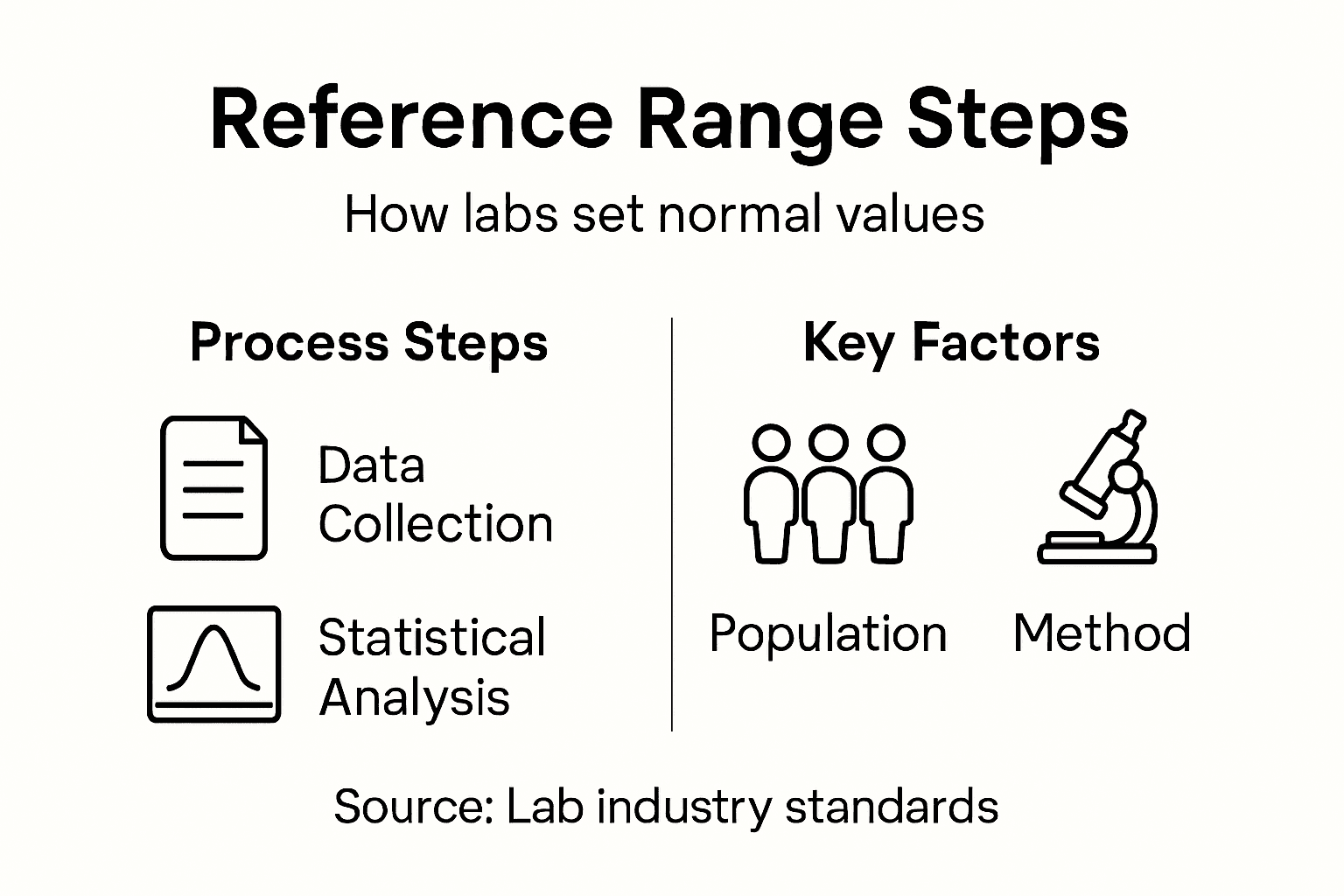
The statistical approach behind range determination follows a consistent framework. Labs collect the test results from their healthy reference population and arrange those values from lowest to highest. They then identify the 2.5th percentile and the 97.5th percentile, which captures the central 95% of values. That 95% interval becomes the reference range. This statistical method means that by definition, 5% of healthy individuals fall outside the range. The specific values chosen depend heavily on the distribution of results. If results cluster tightly around a central value, the range narrows. If results spread out widely, the range widens. Different populations can produce different distributions. A lab serving primarily geriatric patients might establish different reference ranges than a lab serving a younger, generally healthier population. The testing methodology matters enormously too. Calibration consistency, reagent quality, instrument maintenance, and operator technique all influence results. When a lab upgrades to a new analyzer or changes reagent suppliers, they must reestablish reference ranges because the new method might produce systematically different values than the old one.
Labs use electronic data capture systems to track ranges and ensure consistency across time. This technology allows continuous monitoring of how patient results compare to established ranges and flags when something shifts. A lab might notice that average glucose results have drifted higher over several months, suggesting equipment drift or a need for recalibration. Some special populations require custom ranges. Pediatric patients have different normals than adults. Geriatric patients often have ranges that reflect age-related physiological changes. Pregnant women need pregnancy-specific ranges for many analytes. A lab serving a diverse patient population must either establish separate reference ranges for these groups or clearly communicate which range applies to each result. This is where clarity from your lab partner becomes essential. When Centra Diagnostics provides results, the reference range shown reflects the methodology we used and the population it’s meant for. If a result doesn’t fit the clinical picture, part of your verification process should include confirming that you’re comparing the patient to the correct reference range.
The timing and frequency of reference range updates varies by analyte and by lab protocol. Some ranges get reviewed annually. Others might be updated every 2 to 3 years unless there’s evidence of significant drift. Labs that participate in quality assurance programs and proficiency testing can compare their ranges against national standards, which helps catch errors or outdated intervals. You, as a provider, don’t need to memorize this process, but you should know that reference ranges aren’t static or universal. When you see a result that surprises you, asking whether the range is current and appropriate for that specific patient sometimes explains the discrepancy without requiring additional testing.
Pro tip: Ask your lab partner directly about their reference range methodology during onboarding, including how often ranges are reviewed and recalibrated, then request updated reference range documentation whenever your lab changes testing methods or instruments.
Interpreting Lab Results Using Reference Ranges
You receive a lab report. The patient’s hemoglobin is 13.2, and the reference range shows 13.5 to 17.5. Do you call the patient? Do you worry? Do you order follow-up testing? The answer depends on what you actually know about that result and that patient. This is where interpretation becomes both art and science. Simply comparing a number to a range and calling anything outside the range abnormal is lazy and potentially harmful. Real interpretation requires you to understand how to compare test values against the laboratory reference range while considering the specific patient, their clinical presentation, and the context surrounding the test. A result outside the reference range is a signal, not a diagnosis. It tells you to look closer, ask questions, and gather more information. Your job is to figure out whether that signal means something clinically important or whether it’s statistical noise that happens to a small percentage of healthy people.
Start with clinical correlation. This phrase gets thrown around in medicine, but it means something specific here. Does the result make sense given what you know about the patient? If a patient comes in with classic hypothyroid symptoms and their TSH is 6.2 with a reference range of 0.4 to 4.0, the elevated TSH fits the picture. If another patient has no symptoms whatsoever and their TSH is 4.3, you have to consider whether this mild elevation represents disease or just represents the natural variation at the edge of the reference range. Context matters. Is this a single isolated result or part of a trend? One glucose reading of 128 might mean nothing. Three months of readings trending upward from 95 to 108 to 128 means something different. Is the patient fasting or non-fasting? Did they just finish exercising? Are they on medications that affect this value? Are they sick right now with an infection? Each of these factors influences how you interpret the number. A reference range tells you what’s typical in a healthy population, but your patient might have conditions that legitimately shift their baseline without indicating new disease. A patient with chronic kidney disease will have creatinine outside the standard reference range as their new normal, and that’s expected.
Understand the concept of clinical significance versus statistical abnormality. The reference range is a statistical boundary. Results outside it are statistically abnormal. But statistically abnormal doesn’t always mean clinically significant. By definition, 5% of healthy people fall outside the reference range for any given test. If you order 20 different labs on a healthy patient, you’d expect roughly one to be outside the normal range just from random variation. This is sometimes called the multiple comparisons problem. Adding context helps you navigate this. Is the patient symptomatic? Does the abnormal result align with other findings? Does treating this result based on the reference range alone create more benefit than harm? These questions separate thoughtful clinical practice from algorithmic interpretation. When results from different labs show slightly different values for the same patient, resist the urge to panic. Lab-to-lab variation is real and expected. If you’re managing a patient long-term, try to use the same lab consistently so you’re comparing results against the same reference range and methodology. If the patient moves or their insurance changes and they get tested elsewhere, remember that a slight shift in values might reflect lab variation, not clinical change.
One more consideration: your patient needs to understand what the result means, and you need to communicate clearly. When you tell a patient that their lab value is abnormal, you’re creating anxiety. That anxiety is justified if the result is truly clinically significant. But if you’re discussing borderline results or results that require additional testing to clarify, say that explicitly. Patients often think abnormal equals disease, when in reality abnormal might mean “let’s monitor this” or “this is expected given your chronic condition.” The goal of interpretation isn’t to label results as normal or abnormal. The goal is to extract clinically useful information that guides your decision-making and helps the patient understand their health status. Your lab partner should support this goal by providing clear reference ranges, relevant context, and availability for clinical questions when results surprise you.
Pro tip: Before acting on an out-of-range result, ask yourself three questions: Does this result fit the patient’s symptoms and clinical picture? Is this result consistent with previous trends? And if this result is abnormal, what specific action will it change in my management plan?
Risks And Common Pitfalls In Application
Reference ranges are powerful tools. They’re also sources of significant clinical errors when misapplied. The most common pitfall starts with a false sense of certainty. A provider sees a value outside the reference range and assumes it indicates disease without asking whether the context supports that conclusion. A slightly elevated glucose on a single fasting test triggers anxiety. A TSH of 4.5 when the range is 0.4 to 4.0 gets flagged as abnormal. But here’s the reality: misinterpretation of values just outside normal limits without clinical context leads to unnecessary anxiety and inappropriate interventions. The patient gets called with bad news. They start researching online. They request additional testing. Some start over-the-counter supplements or dietary changes based on incomplete information. All of this happens because someone compared a number to a line without considering whether that line actually applies to that specific patient in that specific moment.
Another significant pitfall involves blindly trusting manufacturer-provided reference ranges without validation for your local population or specific testing methodology. A lab might install a new analyzer and simply load the manufacturer’s default reference ranges into the system without verifying that those ranges actually match the results they’re getting from their patient population. This creates systematic error. All results get interpreted against a range that doesn’t fit reality. Regional variations matter too. A lab in a coastal California city serves a different demographic than a lab in a rural agricultural area. Ethnic background influences some analyte values. Age distribution differs. A reference range established for a predominantly younger, wealthier population might not apply when your actual patient base is older or more ethnically diverse. Reliance on manufacturer ranges without local validation, failure to re-validate intervals regularly, and ignoring demographic variations creates conditions for misdiagnosis and overtreatment. Los Angeles, with its extraordinarily diverse population, makes this consideration critical for local providers.
The lab-to-lab variation pitfall trips up many providers. A patient gets tested at their primary care office and then again at a hospital when they’re admitted. The values differ slightly, sometimes enough to change interpretation. The provider’s first instinct is to think something changed in the patient’s health. But the difference might simply reflect that two different labs use two different methodologies with two different reference ranges. One lab’s testosterone level of 450 might be normal. Another lab’s reading of 420 might be low. Neither is wrong. They’re just calibrated differently. When you’re tracking a chronic condition or monitoring treatment effectiveness, this variation becomes noise that obscures the signal. The solution is consistency. Stick with the same lab when possible so you’re always comparing against the same reference range. If a patient must switch labs, don’t panic over modest shifts in values. Wait to see if a pattern emerges across multiple tests.
Communication breakdown creates another category of errors. Providers interpret results but don’t clearly explain the significance to patients. A borderline result becomes framed as abnormal, creating unnecessary worry. Or an abnormal result gets dismissed as not significant enough to discuss, leaving the patient confused when they see it flagged on their portal. Patients sometimes fixate on a single out-of-range value without understanding that one value outside the range happens routinely in healthy people. The provider’s job includes educating the patient about what the result actually means in their context. Does it require treatment? Further testing? Monitoring? Or is it expected given their age, chronic conditions, or current medications? That conversation prevents unnecessary interventions and builds trust. Your lab partner should support this by providing context with results and being available when questions arise. Centra Diagnostics understands that reference ranges are starting points for interpretation, not endpoints for decision-making. We provide clear documentation of which range applies to each result and why, supporting your clinical judgment rather than replacing it.
Pro tip: Create a standing protocol with your lab to flag results that fall just outside the reference range but might not require immediate action, allowing you to review these borderline values during your next clinical assessment rather than making urgent decisions based on statistical abnormality alone.
Navigate Lab Reference Ranges With Confidence Using Centra Diagnostics
Understanding the complexities of reference ranges is essential to avoid misinterpretation and ensure accurate patient care. The article highlights challenges such as lab-to-lab variation, demographic differences, and the critical need to contextualize results instead of relying solely on statistical norms. These pain points can lead to unnecessary patient anxiety, improper treatment decisions, and confusion when results fall just outside the range. Providers need reliable, population-specific reference ranges paired with clear communication to make confident clinical decisions.
At Centra Diagnostics, we specialize in delivering advanced diagnostic testing calibrated for diverse populations and precise methodologies. Our cutting-edge technology and dedicated clinical support help you interpret lab results with clarity. We provide transparent, customized reference ranges that suit your patient’s age, gender, ethnicity, and clinical context. When you partner with us, you reduce the risk of misdiagnosis caused by generic or outdated ranges, empowering better healthcare outcomes.
Improve your diagnostic confidence today by exploring our services at Centra Diagnostics.

Don’t let reference range confusion compromise patient care. Visit Centra Diagnostics now to access comprehensive testing solutions and expert support tailored to your clinical needs. Get started with our reliable testing services and make informed decisions that truly reflect your patient’s health.
Frequently Asked Questions
What is a reference range in lab diagnostics?
A reference range is a statistically defined range that indicates what is considered normal for a specific lab test result, typically representing the central 95% of values observed in a healthy population.
How are reference ranges established by laboratories?
Laboratories establish reference ranges by testing at least 120 healthy individuals, analyzing the data to create statistical percentiles, and determining the interval that encompasses 95% of those values.
Why do reference ranges vary between different laboratories?
Reference ranges can vary due to differences in population demographics, testing methods, sample types, and specific equipment used, which can lead to variability in results for the same test.
How should I interpret lab results that fall outside the reference range?
Results outside the reference range should be considered signals for further investigation, not definitive indicators of disease. It’s essential to correlate the results with the patient’s clinical picture, symptoms, and any previous test trends.
Recommended
- Top Molecular Testing Labs Comparison – Expert Analysis 2025 | Centra Diagnostics
- Best Blood Testing Services for Clinics – Expert Comparison 2025 | Centra Diagnostics
- What Is Blood Work Analysis? Complete Guide Explained | Centra Diagnostics
- Best 6 Molecular Testing Providers Comparison – Expert Insights 2025 | Centra Diagnostics